Travel to Greece
Day 7 Monemvasia - Mystras - Nafplio - Ligourion (241 Km.)
Monemvasia: Monemvasia (in Greek Μονεμβασία; formerly Malvasia), is a fortified medieval town, located on a small peninsula on the east coast of the Peloponnese. The rocky promontory is long and narrow, 1.8 km long and 160 meters above sea level. The old nucleus of Monemvasia is connected by a bridge that leads to the Gefira neighborhood (Γέφυρα), also called Néa Monemvasia (Νέα Μονεμβασία). Monemvasia is a small city with narrow streets with arches and staircases, and which has a good number of historical monuments.

Monemvasia - Main square
The town is surrounded on three of its sides by a fortified wall with towers, which the Venetians built in the 16th century. The wall goes up to the promontory where the citadel is located and closes the fourth flank. On the western flank the main door is located next to a smaller one a little further north. On the eastern flank there is only one small door. The square of the mosque (Πλατεία Τζαμίου) opens in the center of the town, like a terrace towards the sea. In it are located a cistern, a well shaft and a gun carriage. The Church of Christ in Chains (Ναός Ελκωμένου Χριστού), an old cathedral, is located to the east of the square of the mosque (or main square). It was founded in the 12th century and rebuilt in the 18th century. On the left flank the bell tower stands out, decorated with Byzantine reliefs.

Monemvasia - View of downtown
The citadel is accessed via a steep staircase from the city. The citadel is from the Venetian era (16th century) and totally dominates the city and the surrounding area. In the center of the enclosure there are remains of houses, around the 13th-century church of Agia Sophia which conserves frescoes from that period in the narthex, the dome and the apse cap. In the lower part of the city, the Church of Panayia Myrtidoitissa, dating from the 13th century, with Venetian restorations, the Church of Ayios Nikolaos, from 1703, and the Our Lady of Hrisafittisa, from the 17th century, which It houses a famous flying icon, originating from Khrísafa, a town near Sparta.

Crag of Monemvasia
(in 91 Km.) Mystras: Mystras was a fortified city in Morea (Peloponnese) on Mt. Taygetos, near ancient Sparta. Mystras was the capital of the Latin Despotate of Morea, a vassal principality of the Latin Principality of Achaia, established in 1205 after the conquest of Constantinople during the Fourth Crusade. The last Byzantine emperor, Constantine XI, was a despot in Mystras before accessing the throne. Demetrius, the last despot of Morea, surrendered the city to the Ottoman Sultan Mahomet II in 1460. The Venetians occupied the city between 1687 and 1715, but it remained Turkish until 1832, when it was abandoned by King Otto in favor of the new Sparta. In 1989, the ruins (of the fortress, palace, churches and monasteries) were declared a World Heritage Site by Unesco.
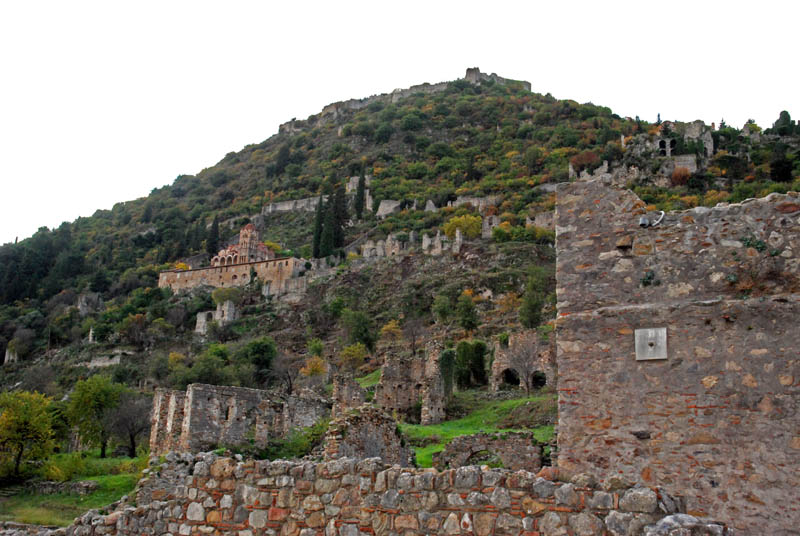
Mystras
We begin the visit to the Mystras archaeological site through the main entrance to the Lower Town. After crossing the portal that crosses the wall, we follow the path that ascends to the right. First we find the church of St Demetrius, also known as Metropolis. From the 12th century, it was the first church built inside the walls. In 1968 a restoration was carried out that allows one to contemplate the beauty of its frescoes. A few meters higher we visit the Evangelistria Church, built between the 14th and 15th centuries in Byzantine style. Due to its funerary function within the castle, it is surrounded by tombs and ossuaries. Despite the poor state of conservation of his paintings, the ensemble stands out thanks to its sculptures and capitals. The next is the Church of Saints Theodores, built between the years 1290 and 1295. Its plan is octagonal and has two chapels on the sides. It has various frescoes from the 13th century, but they are in very poor condition.

Mystras - Pantanassa monastery
The Brontochion Monastery incorporates into it the small church of Hodigitria, or "Aphentikon", as the catholicon monastery. The church was rebuilt and completed around 1310, with some scholars giving 1308-12 as the dates of construction and others 1310-1322. From this point we take a steep slope to the left and arrive at the Orthodox monastery of Pantanassa, founded in the 15th century. It is chronologically the last church built in Mystras under the walls of the Upper City. The beautiful and ornate carved stone facade of the monastery is an important sight. The exterior decoration of the Pantanassa ceramic tiles is an excellent example of a combination of Byzantine and Western elements. The frescoes in the vaults and galleries of Pantanassa were painted around the year 1430; They are of high quality and feature the power of color and movement that sets them apart. We return to the entrance and from there we go with the car to the upper entrance of the citadel. We walked a few meters until we reached the church of Agia Sofía, from the mid-14th century. The three-storey bell tower and 5 sepulchral chapels are still remaining, but the paintings inside are badly damaged.

Mystras - Hagia Sophia
(in 124 Km.) Nafplio: After passing under the castle of Argos, we arrived a few kilometers later at Nafplio, the ancient capital of Greece. Just before the sunset we went to see from one of the docks of the harbour the Fortress of Bourtzi, built on an islet at the time when the city was dominated by Venetians. After dark, we take the opportunity to walk through the pedestrian streets of the old part of the city, decorated with Christmas lights, and do some shopping. Syntagma Square (Platia Syntagmatos) stands out in this area, where we find an old Byzantine mosque from the 16th century, now converted into a theater. The area is full of typical Greek taverns and flower-adorned balconies.

Nafplio - Bourtzi castle
(in 26 Km.) Lygourio: We slept in this town near the Epidaurus Theater.